The slave, Estevanico: silent survivor
Updated: Mar 10
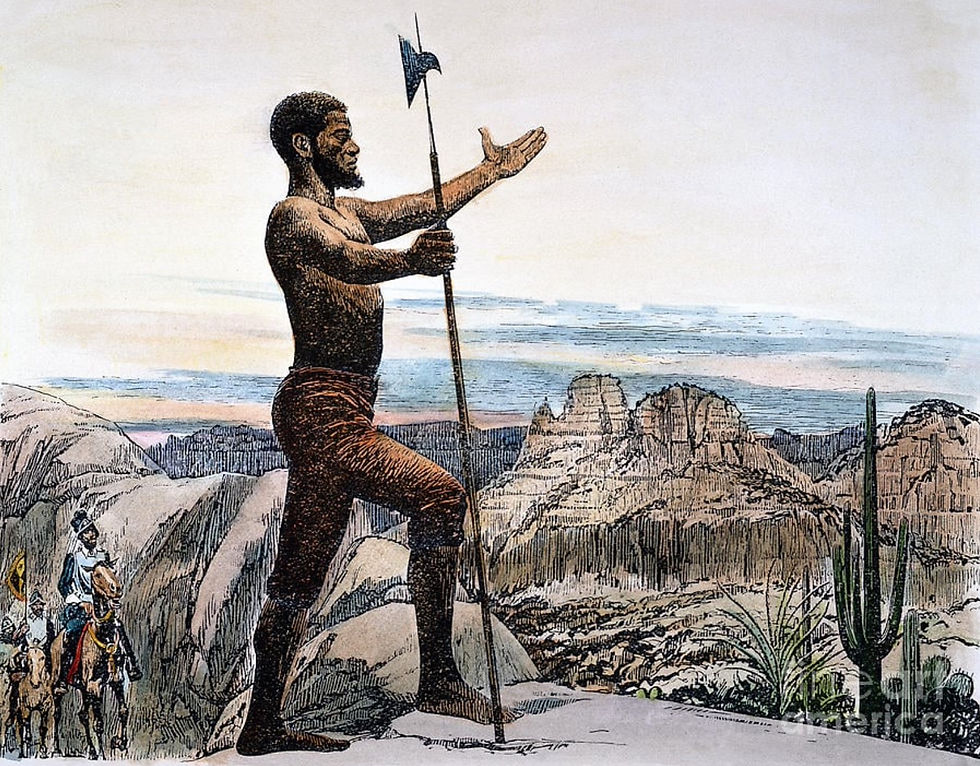
Only four of the 300 conquistadores who landed near Tampa Bay in 1528 survived to reach Mexico eight years later. One of them was a Moor, Estevanico (or Estebanico), described in Cabeza de Vaca’s account as the slave of Captain Andrés Dorantes (another survivor). Although Estevanico is mentioned 13 times in the account, it is never from his own point of view. Nonetheless, he appears to have played an important role in their survival, primarily as someone with a talent for communicating with native peoples by signs or in their languages. In one instance, the others send him forward alone to establish contact with a new tribe. Perhaps the natives were also intrigued by his North African appearance as distinct from most of the Spaniards and other Europeans in the expedition. Estevanico was originally from “Azamor” (Azemmour?), Morocco on the Atlantic Coast. Along with his other talents, he might also have had boating experience, though he apparently couldn’t swim. In other ways he was apparently a very resourceful and durable individual.
Once the four survivors had been rescued in Mexico, they prepared a joint report on their grueling experience. Despite his lower status, Estevanico must have provided valuable, if unacknowledged, input. At least his abilities were recognized by the Viceroy Mendoza of Mexico, who “purchased” him from Andrés Dorantes. Two years later, he became a guide on the expedition of Francisco Vázquez de Coronado to further explore the southwest in search of the mythical, golden Seven Cities of Cíbola. Acting as an advance scout, Estevanico was killed by natives of Cíbola under somewhat obscure circumstances.
Laila Lalami has written an award-winning novel, The Moor’s Account, which is an imagined memoir of Estevanico, portrayed as a remarkable storyteller.


Comments