
- vesmiths
- Nov 14, 2025
- 2 min read
Updated: Dec 4, 2025
I asked this question of my recent acquaintance, Mr. Chat GPT: “Who are the best-known Spanish explorers in American history, in order of their notoriety?”
Here’s the list in order, based on surveying the Web:
1. Christopher Columbus
2. Hernán Cortés
3. Francisco Pizarro
4. Ferdinand Magellan
5. Juan Ponce de León
6. Francisco Vázquez de Coronado
7. Hernando de Soto
8. Vasco Núñez de Balboa
9. Álvar Núñez Cabeza de Vaca
Wikipedia provides a very long list of explorers, their nationalities, and locations they explored, starting with the Egyptian Nehsi in the 15th century BC and including American astronauts. Cabeza de Vaca is there, described as having explored the future United States, Mexico, and Argentina—the latter as leader of his own expedition, following his Narváez experience. Interestingly, the only Narváez mentioned in this list is José María Narváez, a 19th-century Spanish naval commander who explored the Pacific Northwest and served in the Mexican War of Independence. I think Pánfilo de Narváez has been slighted, since he did lead the first major expedition through central to northern Florida and along the entire northern Gulf Coast before it ended disastrously on the coast of Texas. But unlike other conquistadors, he seems to have left no personal record of his career or other writings about himself, according to Chat Gpt. Apparently, he was not a literary kind of guy. All we know about him comes from the Cabeza de Vaca account of his expedition and from the writings of other contemporaries. Although Narváez seemed to imagine himself becoming a great figure in the history of conquests, he was content to let others define his legacy.
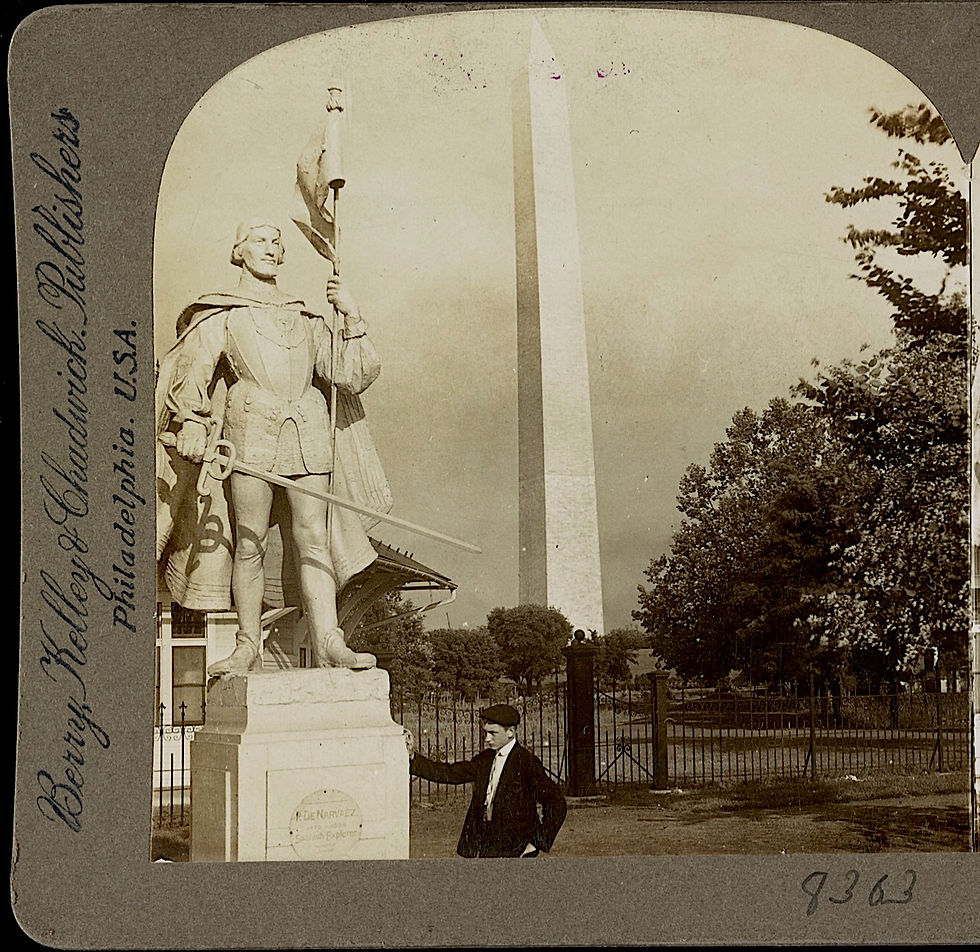
Interestingly, in 1906 a rather heroic statue of Pánfilo de Narváez stood near the Washington Monument, along with one of Andrew Jackson. Yes, Narváez—not Christopher Columbus, Juan Ponce de León, or Hernando de Soto! Back then at least, his expedition must have been considered an important milestone in the founding of America. And what did those historians of 1906 think Narváez and Jackson had in common? Well, they were both authoritarian, vain, impetuous, and bent on conquest and glory. Does that ring any bells today?

- vesmiths
- Oct 28, 2025
- 1 min read

While the expedition was intact, the place where this force of some 270 men spent the most time—about six weeks—was the boat-building campsite at the so-called Bay of Horses, most likely along the St. Marks estuary. There, they constructed five of their ~40-foot boats out of wood, metal, pine pitch, and fibers, built shelters, killed and ate their remaining 17 horses, and buried their dead. All of this activity left quite a mess, and the Soto expedition, which visited the site 11 years later, saw plenty of it left: horse bones, forges, fire pits, etc. But in Florida’s subtropical climate, what could possibly remain nearly 500 years later? Possibly bits of metal slag and charcoal from the forges, fragments of native pottery they made use of, personal jewelry buried with the Spanish dead. Even if no horse bones remain by now, what about horse teeth? In the 1980s archaeologists from the Florida Museum of Natural History in Gainesville collected cow bones and this single horse tooth at the 16th–century Puerto Real townsite on the north coast of Haiti (western Hispaniola). Its DNA is the earliest known from domesticated Spanish horses in the Americas. https://pubmed.ncbi.nlm.nih.gov/35895670/ It also provided evidence that the wild Chincoteague ponies of Assateague Island off Maryland and Virginia are descendants of Spanish horses. https://www.kcci.com/article/centuries-old-horse-tooth-last-piece-genetic-puzzle-assateague-horses/40826170 The fact that this tooth survived burial for five centuries in the tropical climate of Haiti suggests that intact horse teeth could yet be found somewhere along the St. Marks estuary. That would be strong confirmation of the Narváez boat-building site.
- vesmiths
- Sep 25, 2025
- 1 min read

As we discussed earlier (The infamous Requerimiento), bringing Christianity to pagan natives was one of the official rationales for Spanish conquests in the New World. For the Catholic church’s representatives among the invading forces, there no doubt was a genuine desire to save souls. For others, it was the lure of controlling land and profiting from slave labor. Some might have claimed it was the preordained destiny of Spain to conquer new worlds. Conquerers have always tried to put some kind of gloss on their projects to subjugate other peoples for personal or national gain. There may even be some benefit for the conquered people. The Spaniards at least ended the widespread Aztec practice of human sacrifices. But that was only a byproduct of the real motivations for the conquest of Mexico and other territories in the New World: the lust for riches and the control of new lands and peoples. To my mind, the oddest thing about the human lust for wealth and power is that it seems to be insatiable. The more some people gain of both, the more they want or think they need. It’s no different today.


